
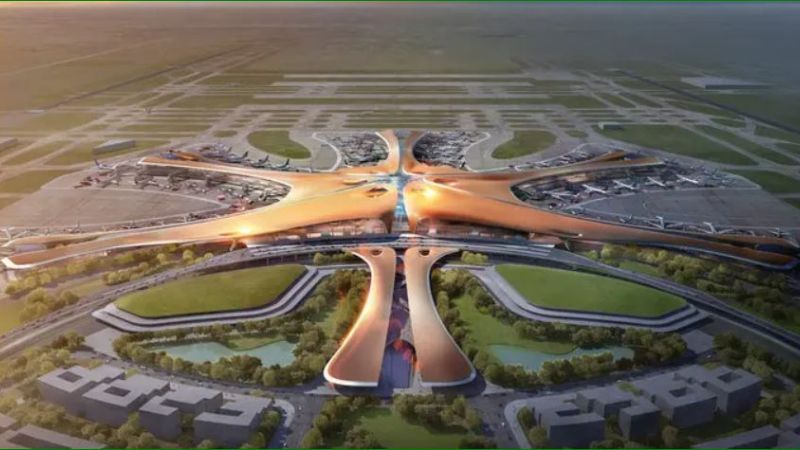

The Dholera International Airport, one of Gujarat’s most ambitious infrastructure projects, is on track to be completed by December 2025. Located about 80 km from Ahmedabad, this greenfield airport is designed to handle both domestic and international traffic, including cargo operations, making it a crucial gateway for industries and travelers alike.
Dholera’s promised international airport has moved from master-plan drawing to visible construction progress. Once operational, the airport won’t just be an aviation facility: it will be a catalytic node that accelerates FDI, shortens logistics chains for high-value manufacturing, and reshapes land-use and residential demand across SIR’s activation area. This article traces the airport’s construction status, projected timelines, the institutions behind it, the expected passenger and cargo profile in Phase‑1, and the knock-on economic and urban-development effects.
What’s on the ground today
Walk the site and you’ll notice graded runways, earthworks, utility trenches, and perimeter fencing. The on-ground works follow a staged approach: site preparation and environmental mitigation; runway and apron formation; airside systems (navigation aids, lighting, drainage); and the passenger terminal, access roads, and utility service nodes. Contractors are coordinating closely with the Dholera authority to ensure that runway alignments, flood-control embankments, and coastal groundwater tables are accounted for in foundation design.
Timeline and milestones
Official schedules from project stakeholders map out a multi-year delivery window with Phase‑1 (basic runway, apron and a modular terminal) targeted for completion in the near term. Ground-based signals — such as the completion of access roads, bulk earthworks, and early-stage utility ducts — suggest that with steady funding and weather windows, partial operations for domestic traffic could begin within the appointed window cited by project updates. Subsequent phases focus on full international-operations certification and cargo-handling capability.
Connectivity and modal integration
The airport is being planned not in isolation but as an intermodal node. The Ahmedabad–Dholera Expressway, proposed freight corridors, and eventual rail or mass-transit feeder proposals aim to integrate surface-to-air flows, meaning a product manufactured in Dholera could be on an aircraft within hours rather than days. By design, the airport’s cargo apron and warehousing zones are sized to handle high-value, time-sensitive consignments — electronics, auto parts, chemicals with regulatory compliance facilities — which will appeal to export-led manufacturing.
Economic effects and land-use transformation
Air access compresses distance to markets and talent pools. Expect premiumization of land parcels near the airport access corridor, a rise in hospitality and corporate accommodation inventory, and a magnet effect for logistics parks, bonded warehousing, and duty-free/SEZ-linked facilities. Property markets may see bifurcation: speculative gains for land not yet serviced, and a steady professional housing demand for those providing airport-centric services.
Environmental, regulatory and community considerations
Airport construction must contend with coastal ecology, groundwater salinity, and storm surge vulnerability. Authorities and contractors are embedding drainage, bunding and compensatory habitat works into the plan. Equally important will be robust community engagement and transparent land-acquisition records to avoid investor and resident disputes.
What to watch next
Key indicators to monitor include civil completion of the runway, issuance of airport safety and operations clearances, international route announcements, and any anchor-cargo or airline MoUs. For investors, timelines for access road handover and terminal operating partner selection are the immediate material events.
The airport is spread over 1,426 hectares and will be developed in three phases. In its initial phase, it will be capable of handling 2 million passengers annually, with future expansion plans pushing the capacity to over 50 million passengers per year — comparable to some of the busiest airports in Asia.
Strategically located near the Dholera Special Investment Region (DSIR) and the Delhi–Mumbai Industrial Corridor (DMIC), the airport will directly support industrial growth, boost exports, and improve regional accessibility. For businesses, it means faster cargo movement, better global connectivity, and a significant push for semiconductor, renewable energy, and manufacturing hubs being set up in Dholera.
With the airport nearing completion, Dholera is positioned to emerge not just as a smart city, but as a global investment destination with world-class connectivity.


Hi, this is a comment.
To get started with moderating, editing, and deleting comments, please visit the Comments screen in the dashboard.
Commenter avatars come from Gravatar.