
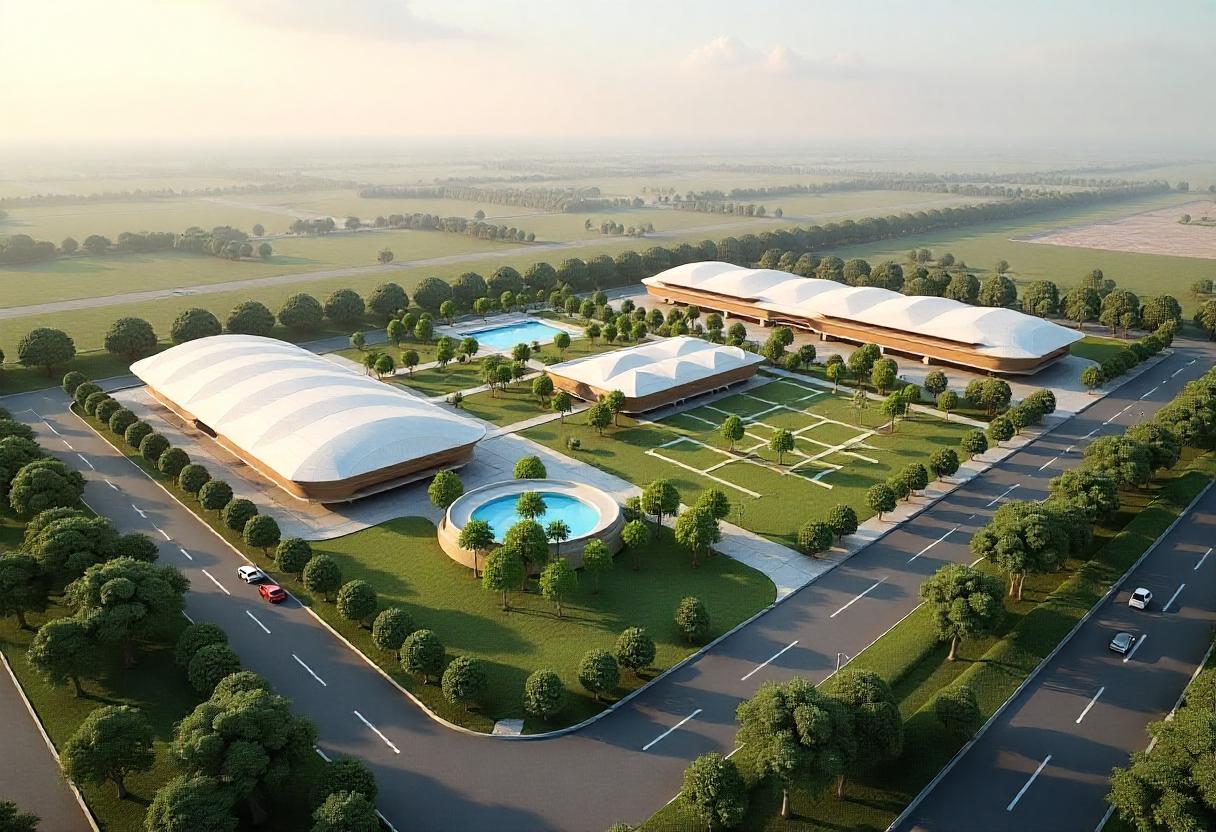

Dholera’s Phase‑1 Activation Area (AA) is the laboratory where the smart city blueprint is tested in real life. Spread across roughly 22.5 sq km, this is the ground-zero zone where trunk infrastructure, utilities, and early smart systems converge. For investors, residents, and businesses, it represents the first tangible proof that Dholera is more than master-plan drawings: it is a functioning ecosystem in the making.
1. Roads and Mobility Infrastructure
Primary & Secondary Roads: The AA features an integrated road network with six- and four-lane arterial roads, complete with service lanes and pedestrian/bicycle tracks. Roads are laid with underground utility ducts beneath — ensuring the city doesn’t need disruptive surface digging for future upgrades.
Smart Traffic Management: Roadside CCTV, IoT-enabled traffic lights, and adaptive signal systems are already embedded. Planners envision a seamless connection with future mass transit systems, including a metro link and bus rapid transit (BRT) corridors.
Electric Vehicle (EV) Readiness: Charging stations have been provisioned at major nodes, with renewable energy integration from the nearby solar park.
2. Water, Drainage & Sewerage Systems
Dual Pipeline Network: Every residential and industrial parcel is connected to a dual system — one for fresh treated water and another for recycled/treated wastewater. This reduces stress on freshwater resources.
Stormwater Drainage: A canal-based drainage grid is integrated with natural flow patterns to avoid flooding. The canals double up as landscaped corridors, offering both utility and aesthetics.
Sewage Treatment: Centralized sewage treatment plants (STPs) are designed to meet stringent effluent norms. Treated water is reused for landscaping, construction, and industrial purposes.
3. Power Supply & Renewable Integration
Substations & Grid: The AA has dedicated 220kV substations feeding a ring-main system to ensure redundancy. Underground cabling reduces outages and improves aesthetics.
Renewable Linkages: With the Dholera Solar Park being developed in parallel, the AA has early access to green energy. This allows industries to meet ESG commitments and reduce energy costs.
Smart Metering: All connections are designed for smart prepaid meters, enabling consumption tracking, remote disconnections, and efficient load balancing.
4. Telecom & ICT Backbone
Fiber-Optic Ready: Ducts for fiber are laid alongside roads, enabling gigabit-speed internet from day one. This supports businesses, residents, and IoT-driven services.
Command & Control Center: The ABCD (Administrative and Business Center of Dholera) building hosts the Integrated Command & Control Center (ICCC), which manages CCTV feeds, emergency response, traffic, utilities, and city services.
Digital Platforms: Resident service apps for grievance redressal, payments, and real-time updates are in development, mirroring models from leading global smart cities.
5. ABCD Building: The Heart of Governance
Purpose: The ABCD building is the administrative anchor of the Activation Area. It consolidates government offices, investor facilitation desks, and the ICCC under one roof.
Features: A green building with LEED certification targets, it also houses conference centers, business incubation hubs, and exhibition spaces for investor roadshows.
Symbolism: Beyond functionality, the ABCD is designed to be the symbolic “first address” of Dholera — where policy, planning, and public-private dialogue intersect.
6. Residential & Commercial Plots
Pilot Housing Projects: Affordable and mid-segment housing pilot projects have been launched to bring the first wave of residents. These serve city staff, construction teams, and early business workers.
Commercial Complexes: Office spaces, retail blocks, and mixed-use centers are planned along arterial roads to activate street life and generate early economic vibrancy.
Township Integration: Developers are encouraged to adopt walk-to-work models and mixed-use layouts that minimize commuting.
7. Smart Systems in Operation
IoT Integration: From smart lighting that adjusts to daylight to waste-collection bins with fill-level sensors, IoT systems enhance efficiency.
Surveillance & Safety: AI-enabled CCTV ensures public safety and real-time crime detection. Emergency call boxes and integrated police outposts improve response times.
Energy Efficiency: Buildings and street lighting follow strict efficiency codes, reducing both operational costs and emissions.
8. Community & Social Infrastructure
Schools & Skill Centers: Skill development institutes are being established to prepare the workforce for advanced manufacturing jobs that Dholera aims to attract.
Healthcare Nodes: Primary healthcare centers and emergency response units are being built with telemedicine capability.
Public Spaces: Parks, sports grounds, and cultural centers form part of the early community design, ensuring livability from the outset.
9. Opportunities & Challenges
Opportunities:
- Ready infrastructure gives investors confidence to set up early.
- Availability of green power and ICT backbone enhances competitiveness.
- Government support ensures streamlined approvals.
Challenges:
- Occupancy is still low; the ecosystem needs anchor tenants to trigger a multiplier effect.
- Long-term O&M requires professional PPP models, not just government oversight.
- Social adoption — convincing people to move in — depends on rapid deployment of schools, hospitals, and jobs.
10. What to Watch Next
- Operationalization of the ICCC in the ABCD building.
- Occupancy levels in early housing and commercial projects.
- SLA (Service Level Agreement) performance metrics for water, power, and ICT.
- Announcement of anchor industries moving into Phase‑1 plots.
- Launch of the first private township with mixed-use zoning.
Conclusion
The Phase‑1 Activation Area is more than infrastructure delivery — it’s Dholera’s proof of concept. By weaving together roads, utilities, smart systems, and early social infrastructure, it creates the foundation for a self-sustaining city. Investors should track how well services perform under real demand, while residents and businesses should see this zone as a barometer of Dholera’s long-term viability.

